
Radon Testing
Illinois has a
radon problem.
Kane, DuPage, McHenry and most of northern Illinois sit in EPA Radon Zone 1 — the highest-risk designation in the country. The only way to know about your house is to test it.
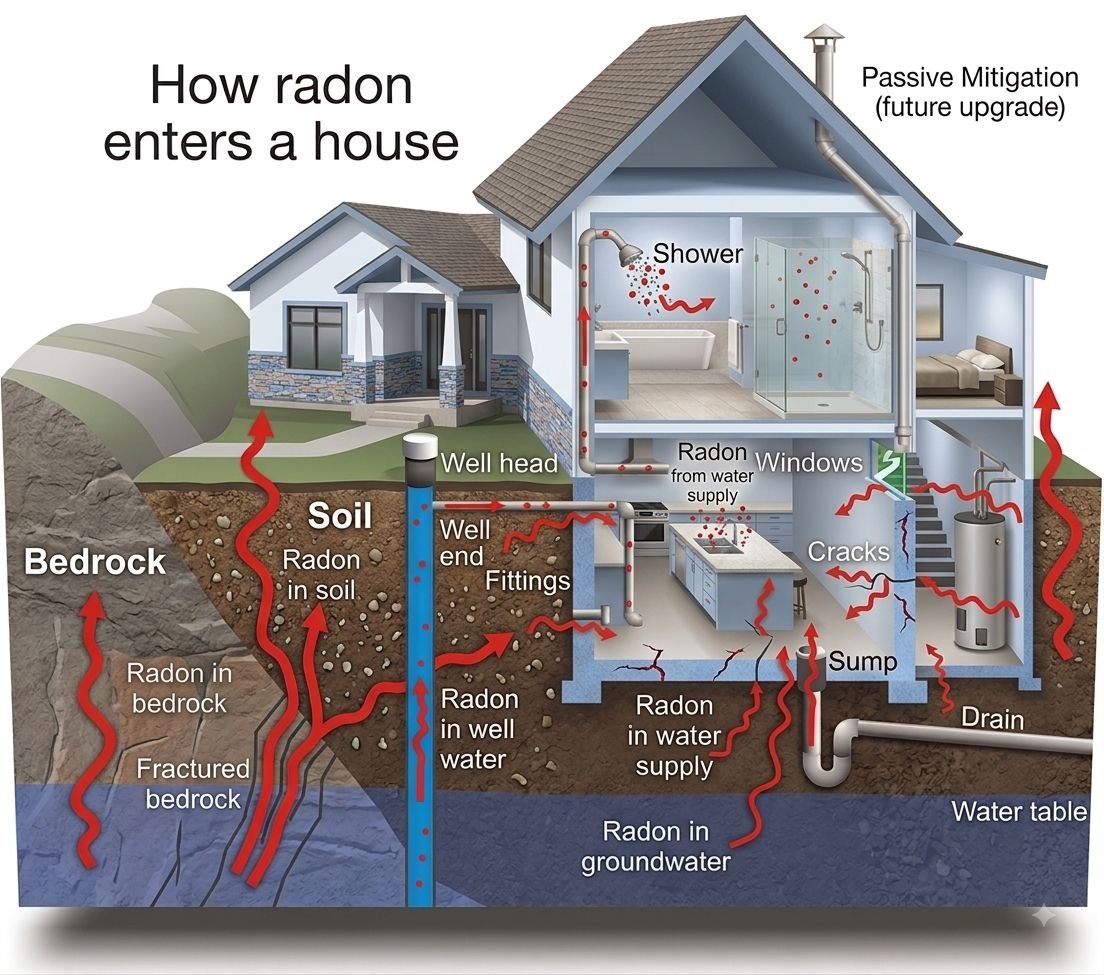
How radon enters a house. Radon is produced by uranium decaying in the soil and bedrock beneath the house, then drawn indoors by the slight negative pressure every heated building creates. It travels up through foundation cracks, control joints, sump pits, slab penetrations around pipes, crawlspace floors and loose fittings — and in homes on a private well, it can arrive dissolved in the water and release into the air at showers and taps. That is why the lowest livable level is where we test, and why two identical houses on the same street can produce completely different numbers.
Radon is a naturally occurring radioactive gas produced by uranium decaying in soil. It's colorless, odorless and tasteless, it enters through foundation cracks, sump pits and slab penetrations, and it is the leading cause of lung cancer among people who have never smoked, according to the EPA.
Northern Illinois has the geology for it. The Illinois Emergency Management Agency recommends that every home be tested below the third floor, and a large share of tested homes in Kane and DuPage counties come back at or above the EPA action level of 4.0 pCi/L.
Two houses on the same street can test completely differently. Your neighbor's result tells you nothing about yours.
Included
How the test works
- Continuous radon monitor, not a charcoal kit — the device records readings hour by hour
- 48-hour minimum placement in the lowest livable level of the home
- Tamper detection — the monitor logs movement, power interruption and unusual conditions
- Closed-house conditions explained to whoever is occupying the home during the test
- Results with your report, including the hourly graph and the average in pCi/L
- Plain-English interpretation of what the number means and what to do next
Context
What the number means
The EPA action level is 4.0 pCi/L. At or above that, mitigation is recommended. Between 2.0 and 4.0, the EPA suggests considering mitigation — there's no level considered entirely risk-free.
A result above the action level is not a reason to abandon a purchase. Radon mitigation is a solved problem: a sub-slab depressurization system typically costs a fraction of what buyers expect, installs in a day, and reliably brings levels down. During a transaction it's often negotiated as a seller-paid item.
A continuous monitor matters here. Charcoal kits give a single averaged number with no way to tell whether a window was opened halfway through the test. The monitor's hourly data shows exactly what happened, which is why it's the standard for real estate transactions.
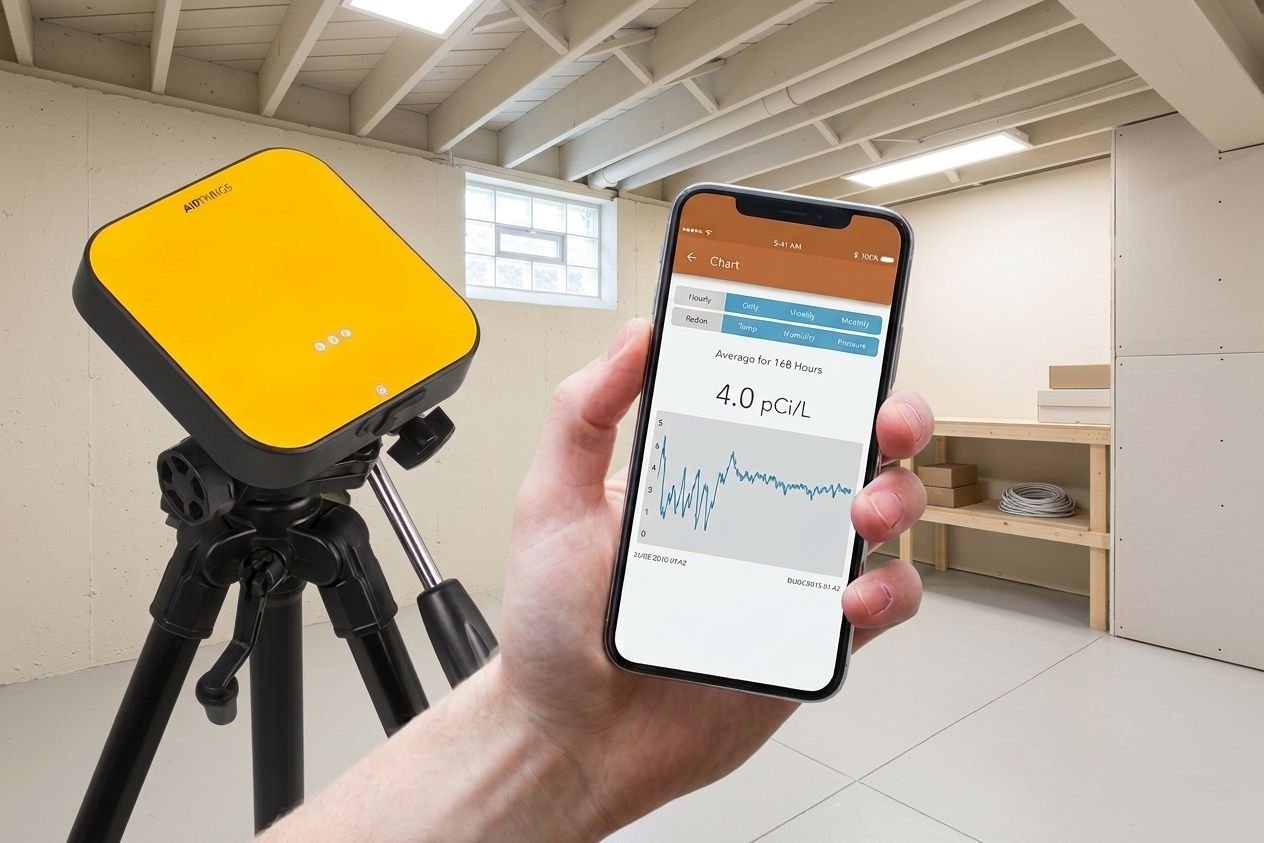
The Corentium Pro logging hourly readings during a 48-hour test
EPA radon zones
Northern Illinois is
Zone 1 — the highest.
The EPA assigns every county in the country a radon zone based on predicted indoor screening levels. Zone 1 counties have a predicted average at or above the 4.0 pCi/L action level. Nearly all of northern and central Illinois — Kane, DuPage, Cook, McHenry, Kendall, DeKalb and their neighbours — sits in Zone 1.
The zone map is a planning tool, not a prediction for your address. It tells you the risk is high enough that testing is warranted; only a test tells you what is actually in the house you are buying.
Radon causes lung cancer. The EPA and the U.S. Surgeon General identify radon as the second leading cause of lung cancer overall, and the leading cause among people who have never smoked. It is odourless, colourless and tasteless — no symptom tells you a house has it, and there is no way to know without testing.
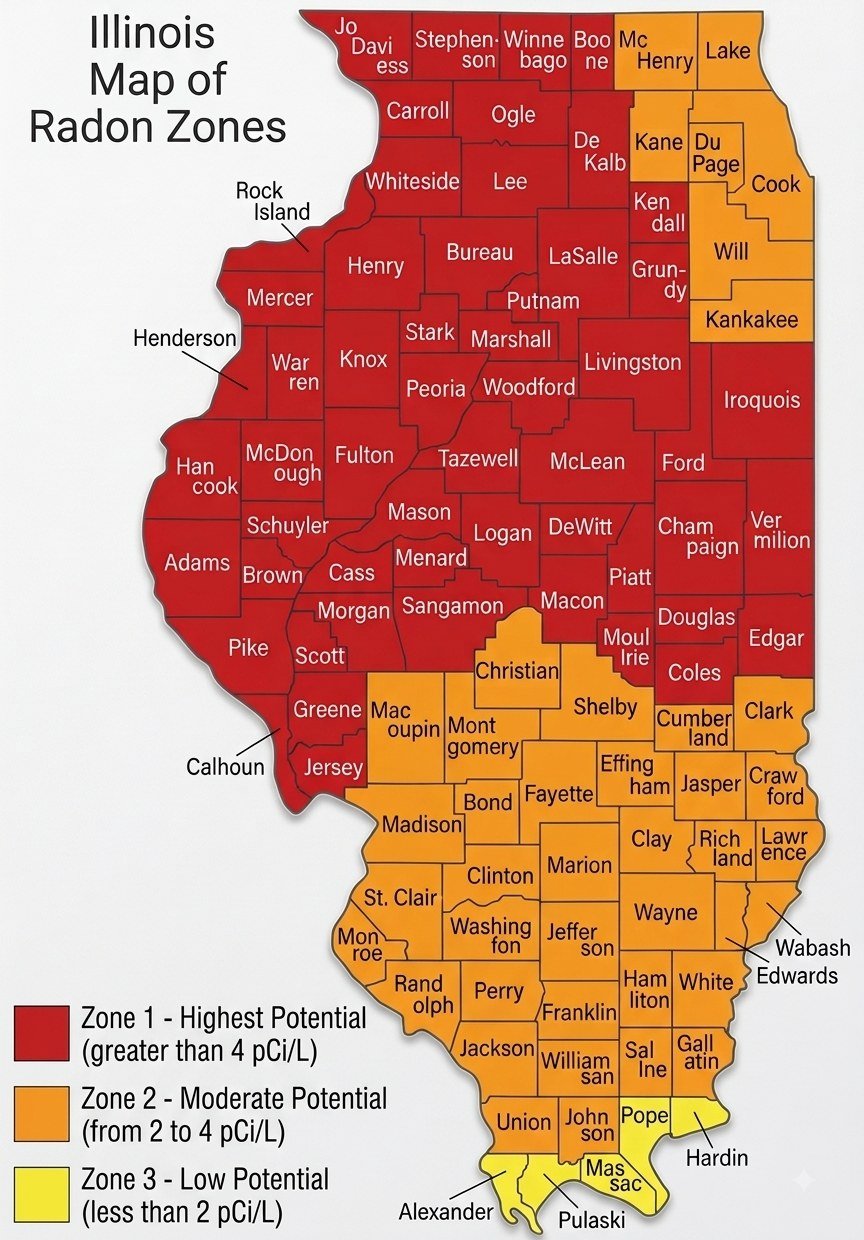
EPA radon zone designations by county. Zones are county-level planning designations, not a prediction for any individual home — only a test tells you what is in the house you are buying.
The equipment
Airthings Corentium Pro
We test with an Airthings Corentium Pro — a professional continuous radon monitor built for real estate measurement rather than homeowner screening. Which device gets used matters, because a radon result routinely moves thousands of dollars in a transaction.
- Multiple independent detectors in one unit, so readings are cross-checked internally rather than resting on a single sensor.
- Hourly logging across the full test period, producing a graph you can actually read rather than one averaged number.
- Tamper detection — the monitor records motion, tilt and power interruption, so an opened window or a moved device shows up in the data.
- Temperature, humidity and barometric pressure recorded alongside radon, which helps explain an unusual reading instead of guessing at it.
- Annual calibration, which is what keeps a result defensible during a transaction.
Why not a charcoal kit? A mail-in charcoal test gives you a single averaged number, days later, with no way to tell whether a window was open halfway through or whether the device sat undisturbed. A continuous monitor answers all of that, which is why it's the standard for real estate radon measurement.
Questions
About radon testing
Can you test at the same time as the inspection?
Yes, and that's the usual approach. We place the monitor at the inspection and retrieve it 48 hours later, so results land inside a typical contingency window.
What are closed-house conditions?
Windows and exterior doors stay closed for twelve hours before and throughout the test, apart from normal entry and exit. Whole-house fans stay off. We explain the requirements to whoever is in the home.
What if the level comes back high?
You'll get the number, the hourly graph and an explanation of the options. Mitigation is straightforward and, in a transaction, frequently negotiated with the seller.
Should I test a home with a mitigation system already installed?
Yes. Systems can fail, get unplugged or be undersized for the house. A post-mitigation test confirms it's actually working.
Also consider
Pairs well with
Pre-Purchase (Buyer's) Inspection
The pre-purchase inspection is the one chance you get to look at a home with a professional, unemotional eye — whi…
Learn more ›Pre-Listing (Seller's) Inspection
The same defect discovered by your inspector is a repair you schedule. Discovered by the buyer's inspector, it's a credi…
Learn more ›Thermal Imaging (Infrared)
Not literally — but it reads surface temperature, and temperature is how hidden moisture, missing insulation and o…
Learn more ›Book an inspection
Book a radon testing.
We'll confirm today.
Closing on a deadline? Call and say so — we hold evening and weekend slots for contingency windows.